
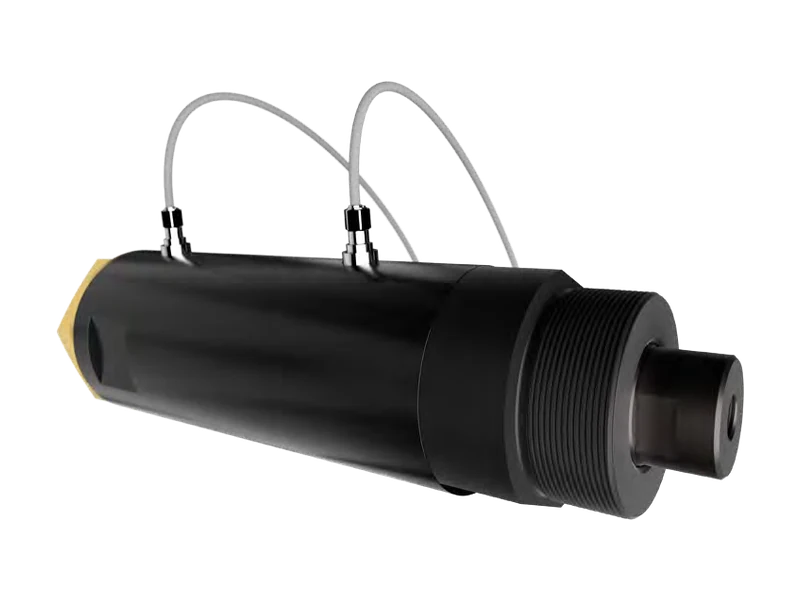
V270CG – Self-locking cylinder
Bore 30–84 mm · Stroke 30–200 mm · 270 bar
 Configure your cylinder ↗Opens vegacylinders.com: register and download all the drawings you want, free of chargevegacylinders.comRequest informationSend your drawing⤓ Download PDF catalog PDF · 1.8 MB
Catalog in English, German, Italian and French.
The V270CG locks the core mechanically between rod and body, so it holds its position even without hydraulic pressure and resists injection pressure. Compact and round, it prevents plastic burrs between pins and mold and allows easy adjustment of the rod preload.
Features
- Mechanical lock between rod and body
- Holds the core without hydraulic pressure
- Resists injection pressure and prevents burrs
- Easy rod preload adjustment: saves time and money
- Integrated inductive sensors
- Seals up to 130 °C · integrated inductive sensors
Technical data
| Bore | 30–84 mm |
|---|---|
| Stroke | 30–200 mm |
| Max. working pressure | 270 bar |
| Max. speed | 0.1 m/s |
| Sealing system | Cartridge: scraper, 2 Viton O-rings |
| Stroke control | Inductive sensors inside the piston chamber |
| Max. temperature | 130 °C without sensors, 80 °C with sensors |
| Mounting | Short-stroke versions with front flange |
Accessories and options
| Limit switches | MSR5 · MSR8 (inductive PNP) |
|---|---|
| Good to know | Prevents plastic burrs between pins and mold, with easily adjustable rod preload. Field-proven mechanical locking. |
Typical applications
- Cores and pins that must withstand injection pressure
- Slides, pins and plugs that create undercuts
- Molds where burrs between pins and mold must be avoided
Quality & durability
Built to last for millions of cycles
We follow, control and inspect production directly at HydroSmart Cylinders. Every cylinder leaves the factory only after it has passed our checks.
100% tested
Every cylinder is tested before shipment to guarantee zero oil leakage.
Premium materials
Chromium-molybdenum steel rods and pistons, steel or 7075 aluminum bodies.
Long-life sealing
Cartridge sealing systems designed to avoid metal-to-metal contact.
Total guarantee
Full technical support and spare parts for every series, with one point of contact.
Need this cylinder?
Configure it online and download the 3D drawing for free, or send us your drawing: we will answer with the right solution for your mold.
Key features
Preload setting
Preload compensates the elastic deformation of the rod, so the core stays fully closed against the cavity during injection. Plan it during mold design, with a mechanical zero reference on the core.
| Bore (mm) | Stroke (mm) → max. preload (mm) | |||
|---|---|---|---|---|
| 30 | 30 → 0.20 | 60 → 0.25 | 90 → 0.31 | 120 → 0.36 |
| 36 | 35 → 0.10 | 70 → 0.13 | 100 → 0.15 | 120 → 0.17 |
| 45 | 45 → 0.15 | 90 → 0.19 | 120 → 0.22 | 150 → 0.25 |
| 56 | 50 → 0.15 | 100 → 0.19 | 120 → 0.20 | 150 → 0.23 |
| 71 | 60 → 0.20 | 120 → 0.26 | 150 → 0.28 | – |
| 84 | 75 → 0.20 | 150 → 0.26 | 200 → 0.30 | – |
The table covers rod elasticity only; the elasticity of the slide, core and connected parts must also be considered.
- Reference gap: 1.00 mm between flange and cartridge. Shim thickness = 1.00 mm − required preload (example: bore 36, stroke 100 → 1.00 − 0.15 = 0.85 mm).
- Check point zero: extend the rod, close the core and check the contact with Prussian blue before setting the preload.
- Hydraulics: keep a constant push pressure of 120 bar for the whole injection phase. If this is not possible, fit a pilot-operated check valve directly on the cylinder with a rigid fitting, never with a hose, and bleed the air.
- Do not exceed the table: excessive preload can prevent correct locking and unlocking. If flash grows as preload increases, the preload is too high: reduce it.
- Mold design: rotating the cylinder to set the preload also moves the oil ports, sensors and cables; leave room for this.
How mechanical self-locking works
At the end of the extension stroke, high-strength sectors expand into a groove machined in the body and lock the rod mechanically. The molding load passes through the sectors into the reinforced body, not through the oil.
The rod must always reach both end positions: control the speed so the locking sectors are not overstressed on return.
Frequently asked questions about the V270CG
How does the V270CG self-locking cylinder work?
At the end of the extension stroke the locking sectors expand into a groove in the body and lock the rod mechanically: the injection load passes into the body, not the oil.
How much force does the V270CG hold?
A bore 45 holds about 20 tonnes with the rod extended, about five times a standard bore 50 cylinder at 200 bar.
How is the V270CG preload set?
With the adjustable preload flange, rotating the cylinder with the mold at temperature, without exceeding the table maximum for bore and stroke. Mount the cylinder outside the mold to leave room for the wrench.
What pressure does the V270CG need during injection?
A constant 120 bar on the push side, or a pilot-operated check valve mounted on the cylinder with a rigid fitting. Minimum 100 bar.
Does the V270CG replace the V260CF?
Yes: same mounting dimensions, a few centimetres longer because of the longer rod guide. The V260CF is out of production.
Do the V270CG sensors need adjusting?
No: they are inductive sensors integrated in the chamber, positioned at the factory and pressure resistant.