
When a standard cylinder is not enough
Real mold projects where a difficult constraint — heat, space, stroke, angle or rotation — became a tailored hydraulic solution. Every case starts from a real problem brought to us by a mold maker.
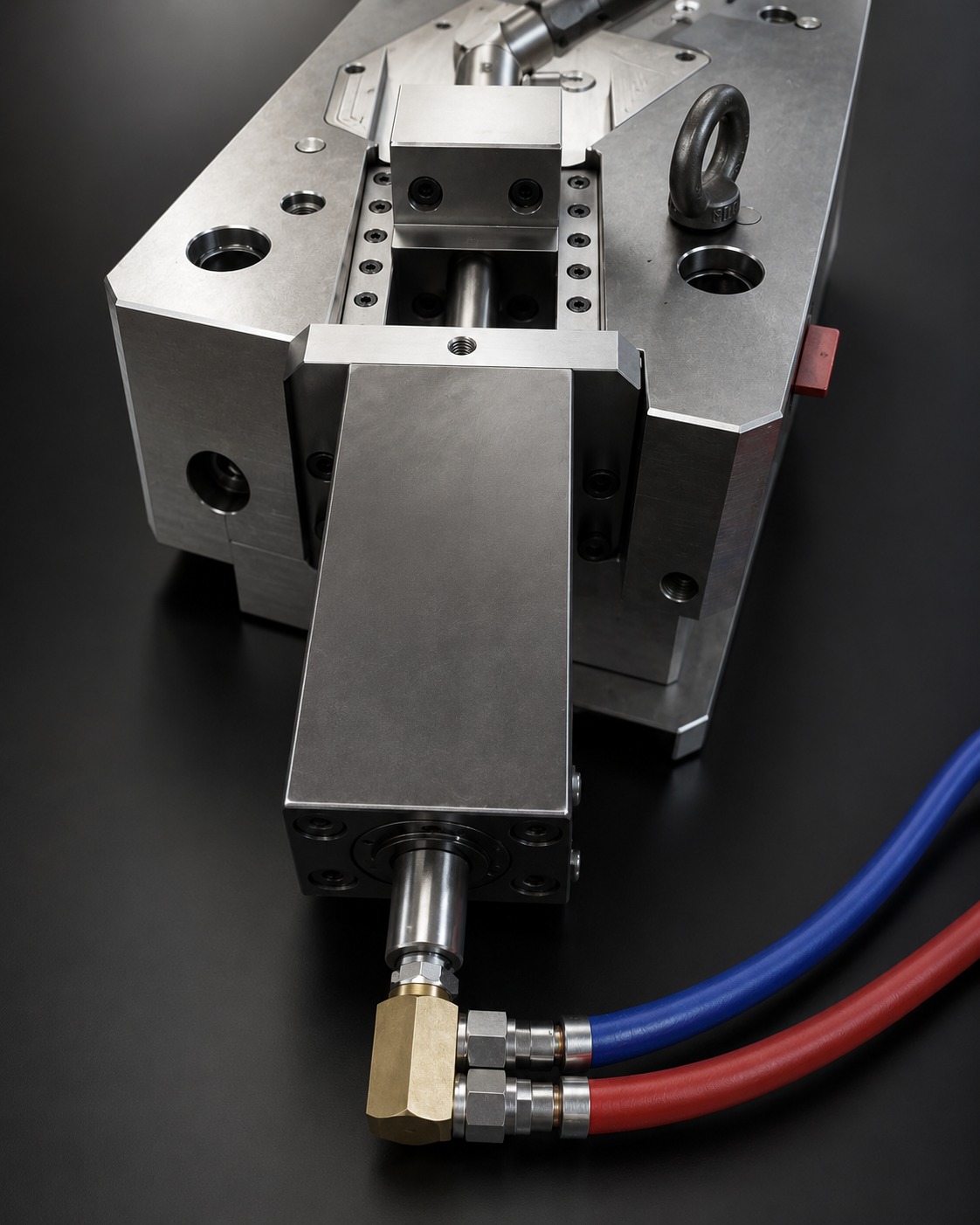
From your mold drawing to the right cylinder
Many molds come with a difficult movement: a slide next to a hot zone, an undercut on an angled axis, a longer stroke than usual, little room around the plates. In these cases the catalog is the starting point, not the end point.
Our technical office studies the space, the mounting points and the mold cycle together with the designer, and proposes a modified standard cylinder or a fully special one.
- Plastic injection molding
- Aluminum die-casting
- Medical
- Packaging machines
- Robotics
- Machining centers and CNC
Hydraulic core pulling: the main layouts
| Layout | How it works | Best for |
|---|---|---|
| Direct drive | The cylinder pulls the core along its own axis | Large cores, simple and efficient force transfer |
| Wedge | The cylinder sits away from the core; a wedge changes the direction | High force in tight spaces |
| Guided puller | The cylinder works with rails or wear plates | Precision, repeatability, high loads |
| Arc core | Hydraulic stroke combined with a rotary linkage or curved track | Curved undercuts |
| Multi-stage | Several cylinders, each moving after the previous one, controlled by sensors and PLC | Parts with several undercuts |
| Unscrewing | Linear stroke turned into rotation by rack and pinion | Threaded parts – sizing guide |
Design rules
- Calculate the force first: include plastic shrinkage, core and guide friction, mold pressure and a safety margin for process variation and wear.
- Never guide with the rod: side loads must never pass through the cylinder rod. Dedicated guides must take static and dynamic loads and keep alignment over the full stroke.
- Wedges need care: wedge faces carry high contact pressure and need hardening and lubrication.
- Sequence with sensors: when movements run in sequence, use position sensors so each core moves only after the previous one has finished.
- Maintenance: check seals, pressure, guide wear, hoses, sensors and fastener torque at regular intervals.
How we work on a special application
- Send us your project2D drawing or 3D model of the mold, or the drawing of the cylinder you use today.
- Feasibility studyOur engineers check space, forces, stroke, temperature and connections.
- Technical proposalA modified standard cylinder or a special one, with the 3D model for your mold design.
- Production and testingEvery cylinder is machined and tested before shipment. Made in Europe.
- SupportHelp with installation and commissioning, total guarantee and spare parts over time.
A mold with a difficult movement?
Send us the drawing: together we decide whether a modified catalog cylinder is enough or a dedicated solution is needed. With the online configurator you can already choose standard cylinders, download 3D models and see prices and delivery times.