
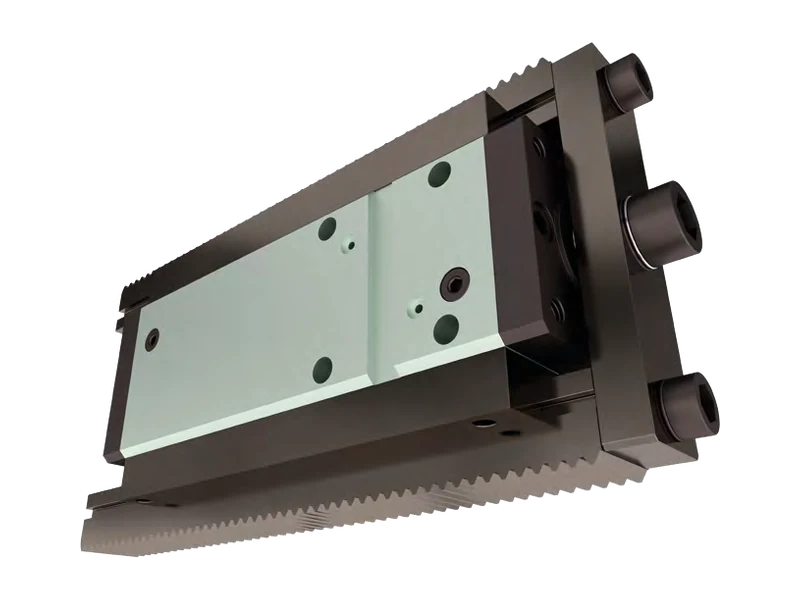
V210CS – Rack-and-pinion unscrewing cylinder
Bore 32–50 mm · Stroke 300–500 mm · 180 bar
 Configure your cylinder ↗Opens vegacylinders.com: register and download all the drawings you want, free of chargevegacylinders.comRequest informationSend your drawing⤓ Download PDF catalog PDF · 1.2 MB
Catalog in English, German, Italian and French.
The V210CS is built on the V220CC block cylinder with one or two racks running parallel to the body, for unscrewing threaded parts. A special screw on the rear head sets the start point of the cylinder and the rack-and-pinion position precisely.
Features
- 1 or 2 racks parallel to the cylinder body
- Precise adjustment of the rack-and-pinion start point
- More compact than tie-rod solutions
- Fast response in unscrewing movements
- Magnetic piston for stroke control
- Based on the V220CC block cylinder with 1 or 2 racks
Technical data
| Bore | 32–50 mm |
|---|---|
| Stroke | 300–500 mm |
| Max. working pressure | 180 bar |
| Max. speed | 0.1 m/s |
| Fluids | ISO VG 46 mineral oil |
| Body | 7075 aluminum alloy, closed by two steel flanges, with 1 or 2 racks |
| Stroke control | Magnetic piston with adjustable magnetic switches (max 80 °C) |
| Mounting | Pinned through-holes with key |
Accessories and options
| Limit switches | MSU4 (magnetic) |
|---|---|
| Good to know | Based on the V220CC block cylinder; an adjustment screw on the rear head precisely sets the start point and the rack-and-pinion position. |
Typical applications
- Unscrewing molds for threaded caps and parts
- Rotary core movements via rack and pinion
- Molds with limited space for unscrewing units
Quality & durability
Built to last for millions of cycles
We follow, control and inspect production directly at HydroSmart Cylinders. Every cylinder leaves the factory only after it has passed our checks.
100% tested
Every cylinder is tested before shipment to guarantee zero oil leakage.
Premium materials
Chromium-molybdenum steel rods and pistons, steel or 7075 aluminum bodies.
Long-life sealing
Cartridge sealing systems designed to avoid metal-to-metal contact.
Total guarantee
Full technical support and spare parts for every series, with one point of contact.
Need this cylinder?
Configure it online and download the 3D drawing for free, or send us your drawing: we will answer with the right solution for your mold.
Sizing a hydraulic unscrewing system
In a rack-and-pinion unscrewing system the cylinder drives a rack, the rack turns the pinions and the pinions turn the threaded cores. Size it in this order:
| Step | Formula |
|---|---|
| Turns to release the thread | turns = thread engagement / pitch |
| Design torque | estimated torque × safety factor (2 standard, 2.5 automotive, 3 medical) |
| Rack force | design torque / pinion radius |
| Piston area needed | rack force / working pressure |
| Rack travel (cylinder stroke) | π × pinion pitch diameter × turns |
| Usable force | calculated force × efficiency (85–95%) |
| Oil flow | piston area × stroke / stroke time |
Worked example
Thread M60 × 5, engagement 20 mm → 4 turns (1,440°). Estimated torque 150 Nm × 2.5 = 375 Nm. Pinion Ø80 mm → rack force 9.4 kN → about 938 mm² at 100 bar → bore 40 mm (1,256 mm², 12.6 kN, margin 1.34). Rack travel ≈ 1,005 mm; doubling the pitch to 10 mm halves it to about 503 mm.
Design checks
- Rod slenderness (free rod length / rod diameter): below 20 very safe, 20–40 usually acceptable, 40–60 needs analysis, above 60 high buckling risk.
- Long racks need a long enough guide: a 1,000 mm rack with about 300 mm of guide risks deflection, poor pinion engagement and wear.
- Count all contact surfaces: on threaded parts the thread flanks add contact area; in one 64-cap mold the real area was almost twice the smooth lateral area.
- Inspections: leaks and fittings every 500,000 cycles; rack, pinion and rod wear every 1 million; seals and alignment every 3 million.
Which thread release system?
| System | Best for | Limits |
|---|---|---|
| Force stripping | Flexible plastics (PP, PE), external threads, short engagement, very high volumes | Not for PC or glass-filled nylon, long engagement or internal threads |
| Manual unscrewing | Very low volumes (up to about 50,000 parts/year) | Slow, not for automatic production |
| Mechanical unscrewing | Medium to high volumes, automatic production, long engagement | Limited force on large or deep threads |
| Hydraulic unscrewing | High torque, internal threads, glass-filled materials, threads above about 50 mm, lights-out production | Higher tooling cost and maintenance |
Frequently asked questions about the V210CS
How does the V210CS work?
It is built on a V220CC block cylinder with one or two racks parallel to the body: the linear stroke turns the pinions of the threaded cores.
How is the unscrewing start point adjusted?
With the special screw on the rear head, which precisely sets the start point of cylinder, rack and pinion.
How do I calculate the V210CS stroke?
Stroke = π × pinion pitch diameter × turns needed to release the thread (engagement / pitch).
What pressure does the V210CS withstand?
Up to 180 bar, with ISO VG 46 mineral oil and adjustable magnetic sensors up to 80 °C.